Women in Colonial America had varying, but distinctive, roles.  Native women of Colonial America did everything around the home.  They cleaned, cooked, made clothing and kept it clean, tended gardens to grow food for the family, engaged in making of pottery and baskets, even engaged in the construction of their homes.  The women were "jacks of all trades" while the man of the house put meat on the family's table.  European women were not used to working hard before coming to America.  They therefore were not engaged in as many activities Native women.  However, European women took care of household chores exclusively, made potteery items, engaged in basket weaving and sewed clothes.
African women first came to America mostly as indentured servants, not as slaves since Europe did not engage in slavery.  They were free to marry, own property and to maintain that property.  THey tended gardens in which they grew food their faqmilies as weel as for the family they worked for.  They also made clothing for their families, as well as pottery to exchange with others.
European women who could afford to have an indentured servant had frew activities and responsibilities in Colonial America.  Often the area in which a familiy settled controlled what activities were necessary for Colonial women to perform.  In areas where the land was not fertile or conducive to growing crops,fishing became a major industry.  Native women worked in the industry as well as in the home.  European women tended to,leave the operation of the industry to the male and confined their efforts to the necessary activities in the home.  Indentured servants performed the activities set out for them by their employers.  Meanwhile, in all cases, the men did all the hunting and fishing for the families.
As with many other Societies, The Chesapeake Colonies went through a period of economic depressiiondue to declining prices in tobacco.  This in turn led to times of great turmoil, Civil Wars, and increased division in the social and political fabric of the colony.  THese times led to a lot of colonists taking out frustrations on the local Indians.  In April 1676, Nathaniel Bacon, a relative of Virginia Governor William Berkeley, led three hundred settlers against peaceful local tribes, killing them all.  When Bacon's force grew to twelve hundred men, he decided to drive all Indian's out of the colony. 
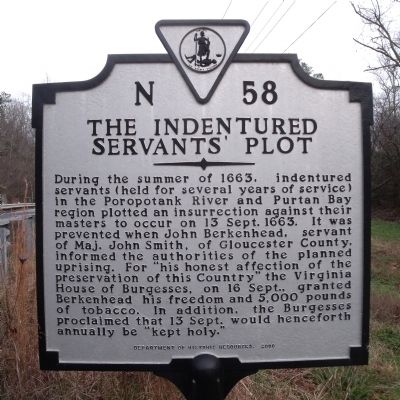
This uprising was known as Bacon's Rebellion.  It only served to make a bad situation of economic depression, racial divide and mistrust worse.  There was also other revolts such as the ones led by Opechancanough the Algonquian Chief who,led the Indian uprising of 1622, aqqnd in 1964 killing about five hundred Virginia Colonists in two days.
By late 1680 there were fewer servants arriving in the Chesapeake.  Considering that most of the labor performed on the tobacco farms was done by these servants, this was not a welcome aspect for this colony.
Chronicle of America.  Mount Kisco, NY; ECAM Publications . Print
http://www.ushistory.org/us/2f.asp
Roark, James L. The American Promise: A History of the United States. Boston: Bedford/ St. Martins,2009. Print
Zinn, Howard.  A People's History of the United States: 1492-present.  New York:  HarperCollins, 1999.  Print
http://explorepahistory.com/images/ExplorePAHistory-a349.jpg
http://www.seaborne-fartygsmagasinet.com/bilder/anno-regniB1-komprwebb.JPG
http://www.shmoop.com/media/images/large/william-berkeley.jpg
http://www.hmdb.org/Photos/88/Photo88792.jpg
http://www.fummo.com/info/image/en/thumb/8/86/860a1edaecf155e5ea769e7d82078a36/dee464da0f703ef56c359f893124dd44.jpg
http://www.foundingfoodies.com/wp-content/uploads/2009/06/tobacco-plant.jpg
http://www.virginiaplaces.org/classschedule/graphics/tobaccooxygen.jpg
Roark, et al., The American Promise, 4th edition, Volume 1. Boston:  Bedford/ St. Martin's, 2009.  Print
http://www/. tobacco,org/resources/history/colonial tobacco.htlm
Middleton, Arthur Pierce.  Tobacco Coast.  Newport News, Virginia:  Mariners' Museum, 1953
Roark, et al, The American Promise, 4th edition, Volume 1, Bedford St. Martins, 2009. Print.
http://historymatters.gmu.edu/d/5800
Declaration of Nathaniel Bacon in the Name of the People of Virginia, July 30, 1676, Massachusetts Historical Society Collections, 4th ser., 187, vol.9: 184-87
http://www.sonofthesouth.net/revolutionary-war/patriots/nathaniel-bacon.htm
Nathaniel Bacon, Son of the South, Site Copyright. 2003-2008
http://www.corbisimages.com/images/67/A1186738-8FEB-4D8C-8AA7-614138E5B6AD/HU061826.jpg
http://www.understandingrace.org/images/482x270/society/colonial-exp.jpg
http://faculty.umf.maine.edu/walter.sargent/public.www/web%20230/jamestown%20settlement.jpg
Richard Middelton, Colonial America,second edition,a history, 1585-1776
Chesapeake in the seventeeth century, essay on Anglo American Society, edited by Thad W. Tate and David L. Ammerman
http://faculty.umf.maine.edu/walter.sargent/public.www/web%20230/unit%205%20virginia.html
The American Promise: A History of The United States, Fourth Edition, Bedford St. Martins,2009
www.nytimes.com/books/.../jones-work.html
Jacqueline Jones, American Work: Four Centuriesof Black and White Labor, W.W.Norton & Company, Inc.,2011
Video lecture Why Europe? (Part 3)
www.webconnections.com/MES5th/ColonialWomen-B4.htm
www.bluecloud.org/role.html
www.wic.org/misc/history.html